
Suction and discharge on the pipeline axis
HPX-S Side Port
The same pump, ported through the sides. Suction and discharge sit on the pipeline axis, so the pump drops straight into an in-line run instead of forcing two elbows into it.
Shorter, cleaner pipe runs with lower friction loss; simpler skid and wall-mount layouts; easier alignment with strainers and pulsation dampeners; and a straightforward swap for in-line pump types without re-piping. Wetted internals, diaphragms and air section are shared with the corresponding HPX model.
11 pages · the side-port range, configured to order
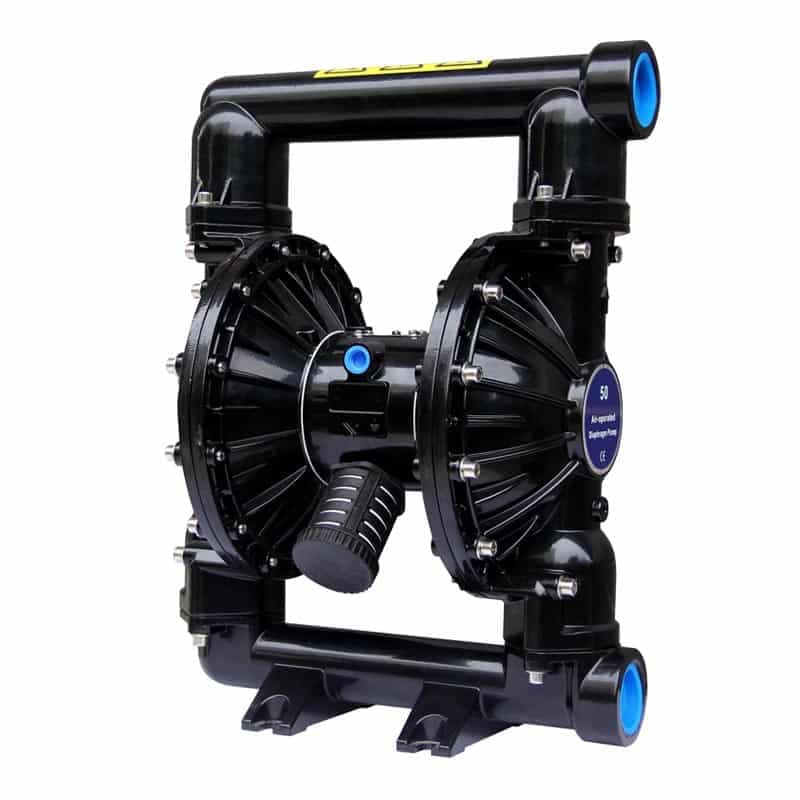
HPXS sizes
Body materials: PP · PVDF · Aluminium · Cast iron · SS304 · SS316.
| Model | Port | Max flow | Max pressure | Solids | Air inlet |
|---|---|---|---|---|---|
| HPXS06 | 1/4" | 19 L/min · 5 gpm | 7 bar | 1.5 mm | 1/4" |
| HPXS15/20 | 1/2" or 3/4" | 57 L/min · 15 gpm | 7 bar | 2.5 mm | 1/4" |
| HPXS25 | 1" | 150 L/min · 40 gpm | 8.4 bar | 3.2 mm | 1/2" |
| HPXS40 | 1.5" | 378 L/min · 100 gpm | 8.4 bar | 4.8 mm | 1/2" |
| HPXS50 | 2" | 568 L/min · 150 gpm | 8.4 bar | 6.3 mm | 1/2" |
| HPXS80 | 3" (DN80, flanged) | 1022 L/min · 270 gpm | 8.4 bar | 9.4 mm | 3/4" |
Maximum free-flow figures, measured with water at 20 °C. Actual duty depends on the installation — send us the duty point and we will size it.
How to specify one
Size and body, then the wetted path in flow-path order.
HPXS 25 PP – PP / TF / TF
series · size · body — seat / ball / diaphragm. The example is a 1" pump with a polypropylene body, polypropylene seats and PTFE balls and diaphragms.
Send us the duty instead if that is easier — fluid, viscosity, solids, temperature, suction condition and the flow and head you need — and we will specify the pump.
Wetted material limits
The most restrictive wetted component governs the pump.
| Material | Minimum | Maximum |
|---|---|---|
| Polypropylene (PP) | +4 °C (+40 °F) | 65 °C (150 °F) |
| PVDF (KV) | +4 °C (+40 °F) | 93 °C (200 °F) |
| PTFE diaphragm (TF) | +4 °C (+40 °F) | 107 °C (225 °F) |
| Santoprene (ST) | −40 °C (−40 °F) | 107 °C (225 °F) |
| FKM / Viton® (VT) | −40 °C (−40 °F) | 177 °C (350 °F) |
| Buna-N (BN) | −40 °C (−40 °F) | 121 °C (250 °F) |
| Polyurethane (PU) | −40 °C (−40 °F) | 93 °C (200 °F) |
Temperature limits are based on mechanical stress only. Certain chemicals significantly reduce safe operating temperature — check chemical compatibility and temperature limits together, and size the pump so the whole duty cycle stays inside the wetted-material window. The most restrictive wetted component governs the pump.